
Reviewed · OLD CITY TOURS
Baku’s Ancient Heart
Baku’s ancient heart is a compact maze of stone lanes, old mosques, caravanserais, baths, artists’ homes, and royal buildings. This walking tour with Heydar begins at the Maiden Tower and connects the city’s Silk Road past with its more recent cultural life. You get legends, local history, and plenty of small details that are easy to miss on your own.
I like the way the route mixes major sights with odd, memorable stops, including a miniature-book museum, the home of jazz musician Vagif Mustafazadeh, and a Soviet film location. I also like the conversational approach: Heydar is described as patient with families, good with teenagers, and happy to answer questions in detail.
The main consideration is time. The advertised duration is about two hours, yet the route includes 17 stops, and one account describes spending nearly four hours with the guide, including lunch at a restaurant in the Old City. You may need to move briskly, skip optional interiors, or allow extra time if you want a slower walk.
What makes this Baku walk worth your time

- A 17-stop route through the UNESCO-listed Old City, including the Maiden Tower and Shirvanshah Palace.
- Stories beyond the usual monuments, from lovers and cats to broken towers and ancient merchants.
- English or Russian guidance from Heydar, with a style that suits families and curious first-time visitors.
- A useful mix of history and modern culture, including jazz, street art, wine, film, and miniature books.
- A small group capped at 15 people, making questions and conversation more manageable.
- A low $25 price, especially useful if you want an orientation before exploring Baku on your own.
Starting at the Maiden Tower
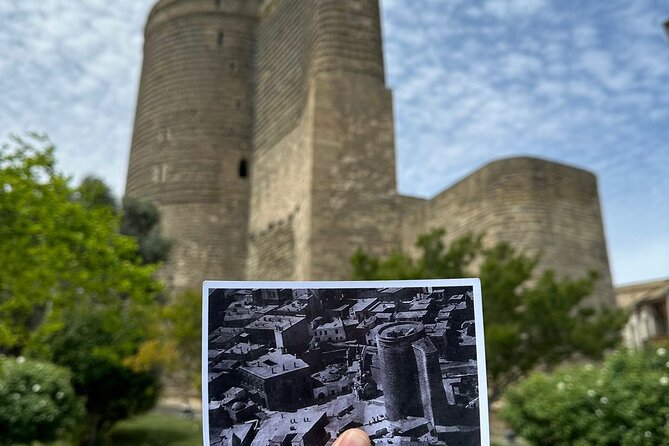
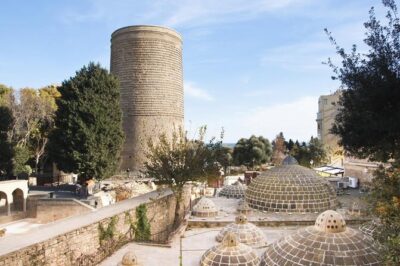
The tour begins at meeting point 16 on Asəf Zeynallı küç, inside Baku’s Old City. From there, the Maiden Tower gives you the right first lesson: Baku’s past is old, layered, and not always easy to explain with one neat answer.
Heydar introduces the tower’s purpose, date, and legends before moving on. The route description leaves room for questions, which matters here because the Maiden Tower has long invited competing explanations. It has been linked to defense, religion, and local stories, and the guide’s role is to help you sort legend from historical context.
You can buy a separate ticket to climb the tower. The stairs are narrow, and there is no elevator, so the climb is not for everyone. If you go up, you get views over the Old City and toward the newer parts of Baku. I would decide early if you want the climb, since it can affect the pace of a short walking tour.
Near the tower, an open-air museum displays more than 50 gravestones found in the area. Local tradition connects this space with a former marketplace used by merchants traveling along the Silk Road. It is a quick stop, but it helps you picture the Old City as a working commercial center, not simply a preserved monument district.
More ways to walk the Old City:
- Baku Oil Heritage & Old Town Walking Tour
★ 5.0 · 232 reviews - Baku Walking Tour (Old City)
★ 5.0 · 127 reviews - Baku Old Town Walking Tour with a Local
★ 5.0 · 64 reviews
Caravanserais and the business of the Silk Road
The Multani Caravanserai and Bukhara Caravanserai offer two of the route’s clearest links to long-distance trade. These fortified lodging places gave merchants a protected place to sleep and store goods. In a city exposed to travelers, traders, and armies, security was not a minor convenience.
The Multani Caravanserai is associated with merchants from Multan, a city in present-day Pakistan. The Bukhara Caravanserai takes its name from Bukhara, now in Uzbekistan. Those names show how far the commercial world connected to Baku, even though the stops themselves are brief.
You will spend only about five minutes at each caravanserai. That is enough for an explanation and a look, but not enough for a long architectural study. Think of these stops as pieces in a larger story about movement, trade, and the practical needs of merchants.
The route then turns to the Monument to Lovers and Cats, a small place with several local legends. Heydar tells both the romantic and sad versions of the stories. This is the kind of stop that gives a walking tour personality. You may not remember every date, but you are likely to remember the tale.
Khans, baths, and Old City daily life
The House of Baku Khans shifts the focus from traveling merchants to local power. Baku was ruled by its own khans from 1747 until 1806, when Azerbaijan was annexed by the Russian Empire. The building offers a glimpse of the city before that political change.
The Yeraltı hamam, or underground bath, sits near the Old City’s main entrance and dates to the 17th century. Historic bathhouses were important social spaces as well as places to wash. This stop also helps explain how old buildings served ordinary needs, not just royal or religious ones.
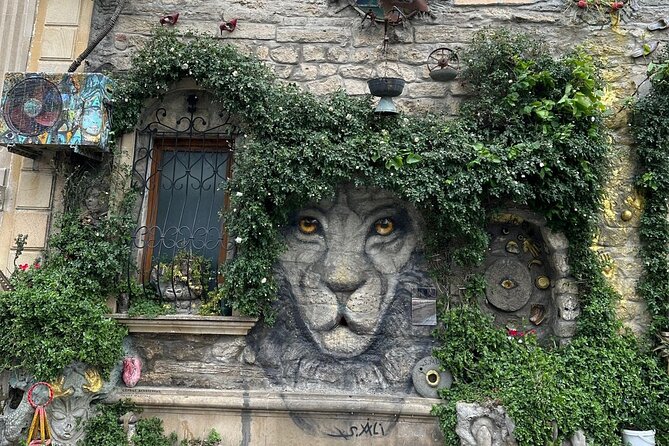
Near the route is the Ali Shamsi workshop, marked by a large lion’s head painted on the wall. You may notice people pausing outside the gallery. It is a useful reminder that the Old City is not only an archaeological zone. Art, work, and daily life continue inside the old walls.
These stops are short, usually about five minutes each. That keeps the tour moving, but it also means you should not expect extended visits or long time inside every building. If a particular bathhouse, workshop, or residence catches your eye, make a note and return later.
Shirvanshah Palace and the limits of a two-hour walk
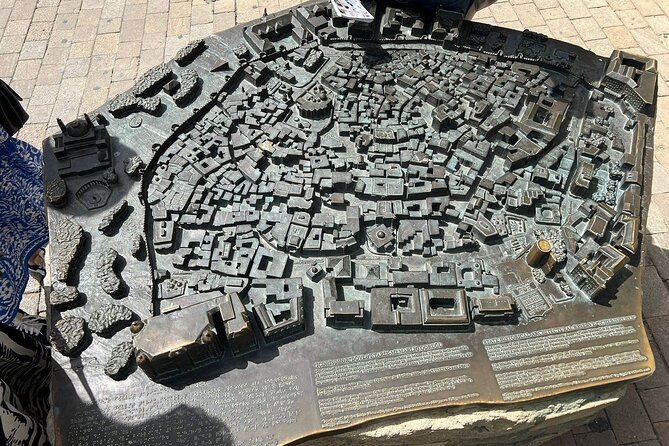
The Palace of the Shirvanshahs is the route’s major royal sight. The palace complex was built between the 12th and 15th centuries for the rulers of the medieval Shirvan state. It was damaged more than once and was restored in 2004.
The palace, the Maiden Tower, and Baku’s Old City entered the UNESCO World Heritage list in 2000. That status is useful context, but the buildings matter even more when you understand how they functioned. The complex served rulers, servants, and the needs of a court, making it more than a single photo stop.
The walking tour does not include entry to the palace. The reason is practical: the complex covers more than a hectare, and a proper visit would take at least another hour. This is one of the clearest tradeoffs in the experience. You get an orientation and historical explanation, then you can return with a separate ticket if you want to explore the courtyards and interiors at your own pace.
I consider this a sensible choice for a two-hour introduction. Still, if the palace is your main reason for visiting the Old City, plan extra time before or after the tour. The walking route gives you the context, but not the full palace visit.
A few more Baku days to weigh up
- Old and Modern Baku Tour ( Day & Night Time)
★ 5.0 · 400 reviews - Full Day Sightseeing Tour of the main Attractions around Baku
★ 4.5 · 388 reviews - Baku: Stunning Walking Tour of Historical and Modern City
★ 4.9 · 270 reviews - Baku Night tour
★ 5.0 · 215 reviews
Tiny books and a poet carved in stone
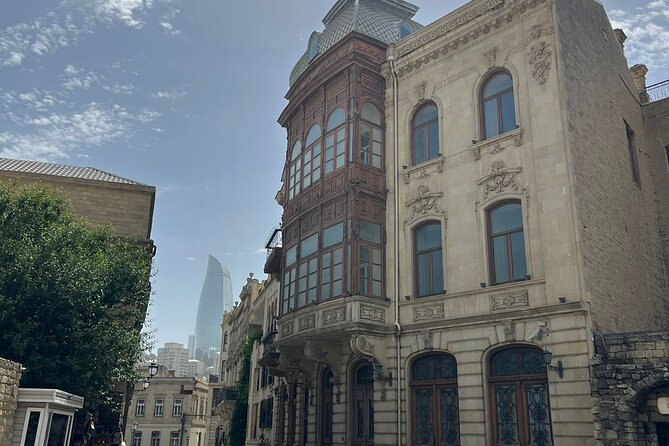
The Baku Museum of Miniature Books is one of the route’s most unusual stops. Books here can be as small as a fingernail, and the collection entered the Guinness World Records in 2014 as the largest collection of miniature books in the world.
The museum also has a miniature Holy Koran from the 17th century. The stop is brief, yet it adds a different kind of cultural detail to the tour. After fortifications, rulers, and mosques, you get an intimate look at the care people have given to books and religious texts.
The Vahid Monument honors Azerbaijani poet Aliagha Vahid, known for satirical poetry. The statue is called the Tree of Life, and the design uses the poet’s head to show the beginning and end of life. It is a compact lesson in Azerbaijani literary culture, especially if you know little about the country’s poets before arriving.
These two stops are good examples of why a guide helps. You can pass the museum or monument without understanding why it matters. With an explanation, they become part of the city’s cultural story rather than random sights along a lane.
Film, wine, jazz, and a living neighborhood
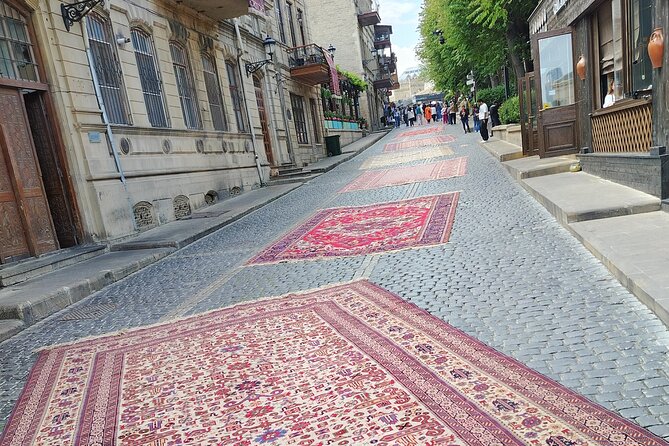
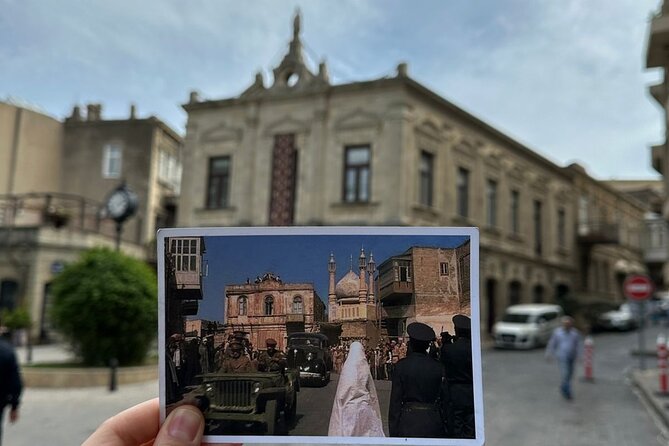
The Aptek Museum and bathhouse stop adds a touch of popular culture. Russian-speaking visitors often ask for the spot connected with the Soviet comedy film The Diamond Arm, filmed in 1968. The Old City contains several historic bathhouses, and one has continued to function as a hammam from the 18th century to the present.
The film connection may mean more to Russian-speaking visitors, but it is still an entertaining reminder that Baku has appeared on screen as well as in history books. The stop also brings you back to the practical life of old neighborhoods, where bathhouses served the community over many generations.
At the Absheron Sharab wine shop, you may taste pomegranate wine if you wish. The tasting is optional, and it is not included in the $25 tour price. Azerbaijan is known for pomegranate wine, so this can be a pleasant local detail, but you should treat it as an add-on rather than part of the core experience.
The House Museum of Vagif Mustafazadeh introduces one of Azerbaijan’s best-known musical figures. Mustafazadeh became internationally known for combining Azerbaijani mugam, a traditional musical form, with American jazz. His story gives the tour a modern cultural note and shows how local traditions can change through contact with outside influences.
Three historic mosques and a changing city
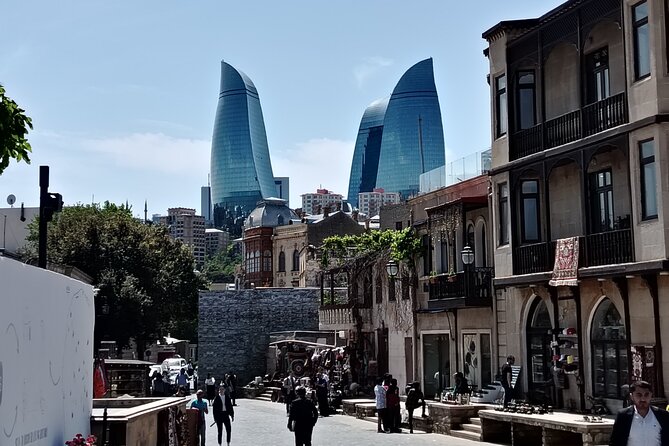
The Muhammad Mosque is described as the oldest mosque in the Old City. It was built in the 11th century, possibly on the site of an earlier Zoroastrian fire temple. Traces of fire and spiritual objects were found beneath the prayer hall, adding another layer to the site’s story.
Local people also call it the Broken Tower. Heydar explains the reason for that name during the visit. This is a good place to ask questions, since the mosque connects ancient religious practice, later Islamic history, and local memory.
The Juma Mosque is the largest mosque in the Old City and dates to the 12th century. It was restored in the early 20th century. The route description identifies it as the only Old City mosque where women are allowed to pray inside, a practical detail that may matter if you are interested in religious buildings rather than viewing them only from the street.
The Lezgi Mosque was built in the 12th century by Ibragim Ashur, also known as the Lezgian mosque. It is currently under reconstruction. The guide explains that the Old City once had 28 mosques, while only some can now be visited or even seen.
That figure gives you a sense of how much the neighborhood has changed. You are not walking through a perfectly preserved medieval town. You are walking through a place shaped by rebuilding, political change, restoration, religious practice, tourism, and everyday use.
What the guide adds to the experience
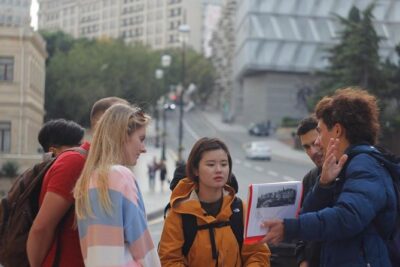
Heydar is the key factor in this tour. The route covers a lot of ground in a short period, and the guide’s style determines whether it feels like a list of dates or a connected story.
The available information describes him as patient, approachable, and attentive to family pace. Teenagers found the explanations understandable, and the tour was described as more of a conversation than a lecture. That is useful if you want to ask about local customs, Soviet-era culture, or the meaning behind a monument.
Heydar guides in English and Russian. The tour is limited to 15 people, which is not a private tour but is still small enough for questions to be practical. If you want a highly formal lecture with long stops at each monument, this may not be the right format. If you prefer a guide who adjusts the explanation and adds humor, it appears better suited.
One account describes the walk lasting about four hours and including lunch at a recommended restaurant in the Old City. The official duration is approximately two hours, so do not build a tight connection around the advertised end time. The longer pace may reflect questions, family needs, lunch, or extra conversation.
Is $25 a fair price?
At $25 per person, the tour is priced as a reasonably affordable introduction to Baku’s historic center. The fee covers the walking tour and a licensed English or Russian-speaking guide. It does not cover optional admission to the Maiden Tower, entry to the Shirvanshah Palace, wine tasting, meals, or tips.
The value is strongest if you are new to Baku and want the Old City explained rather than simply photographed. Seventeen stops give you a useful map of the area, and you can return later to the palace, tower, museums, or bathhouses that interest you most.
The value is lower if you want long interior visits at every major monument. The tour spends around five minutes at many stops, and the palace is specifically viewed from outside. You are paying for interpretation, orientation, and local stories, not a package of entrance tickets.
The meeting point is near public transportation, and the activity ends back at the same meeting point. Most people can participate, and service animals are allowed. Good weather is required. You can cancel for a full refund up to 24 hours before the start time, but cancellations or changes within 24 hours are not refunded.
Who should book this Old City walk?
I would choose this tour for a first visit to Baku, especially if you want a clear introduction before exploring alone. It also suits families, since the route mixes legends, film, music, books, and monuments instead of relying only on long historical lectures.
It works well for visitors who enjoy small cultural details: pomegranate wine, a jazz composer’s home, a lion-headed art workshop, or the story behind a statue of lovers and cats. Russian-speaking visitors may especially enjoy the film connection, while English speakers get the same route with an English-speaking guide.
You should think twice if you have limited mobility or dislike narrow stairs. The Maiden Tower has no elevator, and the Old City includes cobblestone lanes and historic buildings. The supplied information says most people can participate, but it does not promise a step-free route.
Should you book Baku’s Ancient Heart?
Book it if you want a friendly, story-led introduction to Baku’s Old City for a modest price. Heydar’s conversational style, the mix of famous landmarks and unusual stops, and the small group limit give the walk more character than a simple monument checklist.
Skip it if you want the full interior visit to Shirvanshah Palace included or need a strict two-hour finish. In that case, use the walk as an introduction only, then return independently to the palace and Maiden Tower. Leave extra time in your schedule, since questions, optional climbs, or a longer conversation can stretch the experience.
FAQ
Where does the tour begin?
The tour begins at meeting point 16 on Asəf Zeynallı küç in Baku, Azerbaijan.
Where does the tour end?
The activity ends back at the meeting point.
How long does the tour last?
The advertised duration is approximately two hours. A longer pace is possible, and one described experience lasted about four hours, including lunch at a restaurant in the Old City.
Is the Maiden Tower included?
The tour stops at the Maiden Tower and explains its history and legends. Entry to climb the tower requires a separate ticket.
Does the tour enter the Palace of the Shirvanshahs?
No. The route explains the palace from outside, but entry is not included because a full visit would require at least another hour.
What languages does the guide speak?
The licensed guide provides the tour in English and Russian.
How many people can join?
The maximum group size is 15 travelers.
What is included in the $25 price?
The price includes the walking tour and the licensed English or Russian-speaking guide. Tips, attraction admission, wine tasting, and meals are not included.
Just added around Baku
- Wine Tour Baku★ 5.0 · 4 reviews
- Baku Sightseing Tour★ 5.0 · 12 reviews
- Traditional Azerbaijani Cuisine Workshop★ 5.0 · 5 reviews
- The Magnificent Baku Night Tour★ 5.0 · 3 reviews
- Day Trip in Baku★ 5.0 · 6 reviews
- Guided Old City Tour on Baku’s Timeless Charm★ 5.0 · 4 reviews
- Baku Old City Tour★ 4.5 · 12 reviews
- Paragliding Tour Baku★ 5.0 · 3 reviews
Old City Tours, compared.
Guba Khinalug & Candy Cane Mountains tour (by Old City Tours)
Read our review →
Baku Old City Tour (officially by Old City Tours)
Read our review →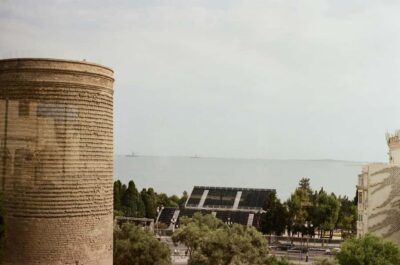
Baku Old City Wonders: A Walking Tour Through Time
Read our review →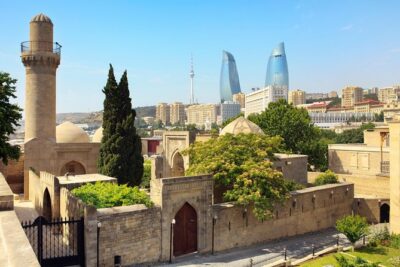
Browse the lists this tour appears in